House dust is the major cause of year-round runny or stuffy nose, itchy, watery eyes, and sneezing for allergy sufferers. Dust can also make people with asthma suffer attacks or wheezing, coughing and shortness of breath.
Why does house dust cause allergic reactions?
House dust is a mixture of many kinds of waste materials. Its content varies from home to home, depending on the type of furniture, building materials used, presence of pets and other factors. A speck of dust may contain fabric fibers, human skin particles, animal dander, microscopic creatures called mites, bacteria, parts of cockroaches. mold spores, food particles and other debris. A person may be allergic to one or more of these substances, and, if exposed to the dust, will have an allergic reaction.
Is dust allergy a sign of a dirty house?
No, a dirty house can make a house-dust allergy problem worse, but in all likelihood, normal housekeeping procedures may not be enough to relieve house-dust allergy symptoms. Tiny creatures called house dust mites seem to be the major allergen (cause of allergic reactions) in house dust. A recent study in England showed that 10 percent of the general population and 90 percent of people with allergic asthma have positive skin tests for allergy to dust mites. Recent studies in the U.S. suggest that at least 45 percent of young people with asthma are allergic to dust mites.
People allergic to dust mites react to proteins in the bodies and digestive waste (feces) of the mites. These waste particles are so tiny and light that they float easily into the air when anyone walks on the carpet or disturbs bedding. When allergic people inhale these particles. they suffer symptoms.
No matter how vigorously you dust or vacuum. you will not reduce the number of dust mites present deep within carpeting and mattresses. In fact, usual cleaning methods actually put more dust into the air, making symptoms worse.
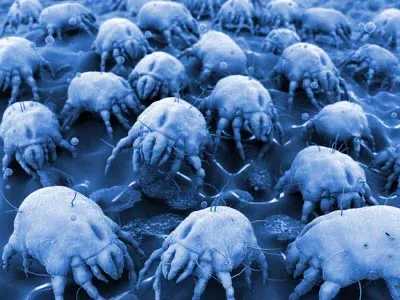
What are dust mites?
Dust mites belong to the family of 8-legged creatures called Arachnids. This family also includes spiders. chiggers and ticks. Dust mites - which can only be seen with a microscope - are hardy creatures that live well and multiply easily in warm, humid places. They prefer temperatures at or above 70°F. with relative humidity at 75-80 percent. Mites die when the humidity falls below 40-50 percent and are rarely found in very dry climates.
As many as 18,875 dust mites can live in one gram of dust, but the usual population is about 100 to 500 mites per gram. (A gram is about the weight of a paper clip). Each mite produces about 10-20 waste particles each day and lives for 30 days. Egg-laying females can add 25-30 new mites to the population.
Mites eat particles of skin and dander and thrive in bedding. carpeting, upholstered furniture, clothing. closets and automobile seats – all likely to contain skin particles. Dust mites don’t bite, cannot spread diseases and never live on people, only in the environment. They are harmful only to people who become allergic to them. While usual household insecticides have no effect on dust mites, a new product (described later) is now available to kill mites and help remove them from carpeting.
Are house dust allergies seasonal?
In the U.S., mite populations appear to peak in July and August, and allergen levels stay high through December. Allergen levels are lowest in April and May. Although dust mite populations decrease during winter in areas where the climate is cold and dry, some sensitive people report that their symptoms get worse at that time! That’s because mite fecal particles and pieces of dead mites, both of which trigger dust mite allergy, are still present. Forced-air heating systems blow these panicles up into the air, and, as dust dries out over time, even more of the particles become airborne. People may get fewer symptoms in the summer because they spend more time outdoors and need not run the furnace indoors.
How do I know if I have dust mite allergy?
If you think you may have an allergy to house dust mites, consult an allergist. To pinpoint the cause of your symptoms, the allergist may ask questions about your work and home environments, eating habits, family medical history, frequency and severity of symptoms, exposure to pets and a variety of other questions. Your allergist may employ skin testing, observing your body’s reaction to various possible allergens placed under the skin. A positive reaction (a raised welt with redness around it) shows that you are allergic to that allergen. Skin testing is the easiest, most sensitive and least expensive way to identify an allergy. In some cases, however, skin lest results may be unclear and your allergist may require a RAST test – analysis of a small blood sample – to confirm the diagnosis.